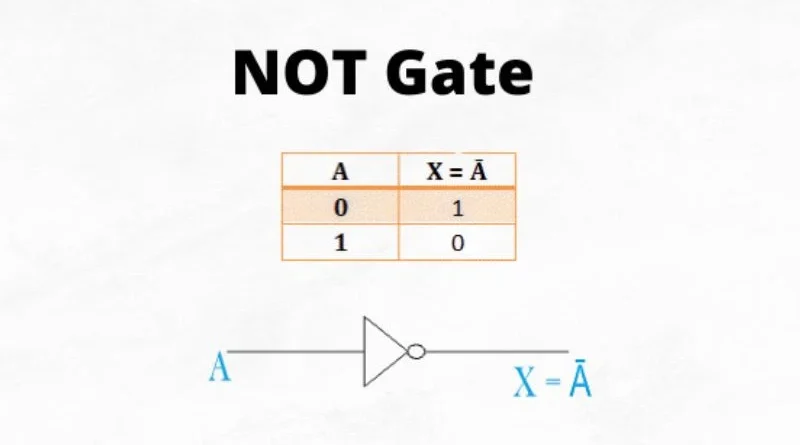
In the dynamic scenario of digital electronics, where binary language orchestrates the complexity of modern computers, the “Not Gate” appears as a fundamental element that weaves the threads of logical inversion in the structure of digital circuits. As we embark on a journey to unravel the mysteries and complexities of Not Gate, we delve into the heart of electronic systems, where the fundamental principles of signal manipulation and logical operations converge. Symbolized by a simple triangle with a circle on top, the meaning of Not Gate goes beyond its minimalist representation and serves as an axis in the architecture of digital logic.
The ubiquitous digital systems in our interconnected world owe their ability to reverse signals to the humble emergency gate. This basic operation forms the basis for the entire binary computing system. In this comprehensive exploration, we will walk through the internal architecture of the emergency gate, examine its applications in various digital circuits, and evaluate its benefits against the challenges it presents. From the basic truth table to the intricacies of combinatorial logic, the emergency gate is an indispensable part of the mosaic of electronic design, shaping the technological landscape that defines our modern era.
What is an emergency gate?

The emergency gate, also called inverter, is a basic logic gate that performs negation. In simpler terms, it takes an input signal and produces the opposite output signal. The output signal is low when the input signal is high and vice versa. Symbolically represented by a triangle pointing to the right with a small circle on top, the emergency gate forms the basis of the digital circuit design.
The anatomy of an emergency gate
The internal structure of the emergency gate is elegantly simple, but crucial to its functionality. Typically, it is built with semiconductor devices such as transistors, and its core includes inversion logic. A simple emergency gate usually consists of a single transistor, where the input signal controls the state of the transistor, resulting in an inverted output. This simplicity forms the basis of digital logic design and allows for precise manipulation of binary information.
Internal structure
Basically, an emergency gate consists of semiconductor components, usually transistors. The simplest form of emergency gate consists of a single transistor where the input signal controls the state of the transistor, resulting in an inverted output. This inversion process is crucial in digital systems and allows logical operations essential to computing and communication technologies.
Truth table
Understanding the behavior of an emergency gate is crucial for any digital designer. The truth table for a Not Gate is simple:
| Prohibited | exit |
|---|---|
| 0 | 1 |
| 1 | 0 |
This concise table captures the essence of how the emergency gate works and shows the inverse relationship between its input and output signals.
Applications in digital circuits
Emergency doors are used in several essential applications for electronic systems. They perform signal inversion, a fundamental process in circuits such as flip-flops, memory devices, and microprocessors. In combinatorial logic, they contribute to the creation of logical functions, thus improving the versatility of digital systems. Not gates play a central role in pulse formation and optimizing signal transmission in communication systems.
Signal inversion
The main function of an emergency gate is to invert the input signal. This inversion finds application in various digital circuits such as flip-flops, memory devices and microprocessors. Signal inversion ensures proper synchronization and coherence within these complex systems.
Combinatorial logic
Gates do not play a central role in combinational logic circuits where the output depends exclusively on the current input values. When combined with other logic gates, Not Gates help create various logic functions, improving the versatility of digital systems.
Wrist shaping
In communication systems, the emergency port is used to form pulses. By inverting the pulses, the desired waveform characteristics can be achieved and the signal transmission and reception processes can be optimized.

Advantages and challenges
Not Gates are simple in design and implementation and therefore cost-effective. Its ability to perform logical inversion allows for a variety of logical operations. Challenges include propagation delay, especially in high-speed applications, and power consumption, an issue in large-scale systems. Designers address these challenges through optimization techniques and innovative approaches to ensure optimal gateless performance.
Benefits
- Simplicity : Non-gates are easy to design and implement, which makes them cost-effective and allows them to be widely used in a variety of electronic systems.
- Logic Reversal : The ability to invert signals is crucial in digital systems as it allows for a wide range of logical operations.
challenges
- Propagation Delay : As with any electronic component, emergency gates introduce some propagation delay. Minimizing this delay is critical in high-speed applications.
- power consumption : In large digital systems, the cumulative power consumption of multiple emergency ports can be a problem. Designers often optimize circuits to solve this problem.
Future trends and innovations
As technology develops, the design and application of emergency gates also evolves. The integration of advanced materials such as nanomaterials and quantum dots promises to improve the performance and efficiency of these fundamental components. Additionally, innovations in low-power design techniques aim to address the power consumption challenges associated with emergency doors in modern electronic systems.
Conclusion
In summary, the emergency gate is a fundamental force in digital electronics, embodying simplicity and deep functionality. Its internal structure, often a single transistor, enables the essential process of logic inversion, laying the foundation for complex digital circuits. From applications in signal inversion, combinational logic and pulse shaping to advantages in simplicity and logical operations, the emergency gate plays a central role in many electronic systems. However, challenges such as propagation delay and power consumption remain, driving continued innovation in digital circuit design. As technology advances, the future promises better performance through the integration of new materials and energy-saving design techniques. The emergency door remains a cornerstone in the ever-evolving landscape of digital logic and is shaping the future of electronic systems.
Common questions
1. How does an emergency gate contribute to signal inversion in digital circuits?
Through its internal structure, generally composed of transistors, the emergency gate performs a logical inversion producing an output opposite to the input. This inversion is fundamental for several applications, including signal synchronization and combinational logic.
2. What are the advantages of emergency gates in digital circuit design?
Not Gates feature a simple design, which makes them cost-effective and easy to implement. Its ability to perform logical inversion is an important advantage that allows various logical operations in digital systems.
3. How do designers deal with challenges associated with emergency doors, such as propagation delay and power consumption?
To reduce propagation delay, designers are using optimization techniques and exploring advances in materials such as nanomaterials. Challenges related to power consumption are addressed through innovative low-power design techniques in large-scale digital systems.