What is the Cochran Caldera?
The Cochran boiler is a vertical drum shaft, natural circulation, natural draft, low pressure, multitube, solid fuel fired, fire tube boiler with internal burning furnace. It is the modified form of a simple vertical boiler. In this boiler, the fire tubes are placed horizontally. The efficiency of this boiler is much better than the simple vertical boiler.
Main parts and construction
1. Shell: It has a cylindrical drum with a vertical axis with a hemispherical dome-type shell on the top.
2. Grating: It is the platform where solid fuel is burned.
3. Combustion chamber : The burning of fuel takes place in the combustion chamber.
4. Fire tubes: The Cochran boiler has multi-tube fire tubes. The hot combustion gases from the combustion chamber travel to the smoke box through these flue tubes. Fire tubes assist in exchanging heat from hot combustion gases to water.
5. Fire Hole : It is the hole provided for burning the fuel inside the furnace.
6. Furnace: It is located at the bottom of the boiler. The furnace is the place where all the fuel is burned. Without the furnace, the operation of this boiler is not possible.
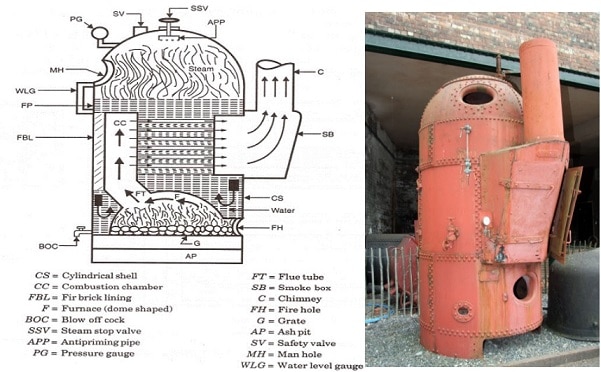 cochran boiler diagram and operation
The characteristics of the Cochran boiler are listed below:
Advantages of the Cochran boiler
(i) Low initial installation cost.
(ii) Requires less usable area.
(iii) Easy to operate and handle.
(4) Transporting the Cochran boiler is easy.
(V) Can use all types of fuel.
Disadvantages of the Cochran boiler
(i) Low steam generation rate.
(ii) Inspection and maintenance are difficult.
(iii) A high ceiling is required for installation due to the vertical design.
(4) It has a limited pressure range.
Cochran Boiler Applications
- Variety of process applications in industries
- Chemical Processing Divisions
- Pulp and paper mills
- Refining Units
Furthermore, they are often employed in power generation plants where large quantities of steam (ranging up to 500 kg/s) with high pressures, i.e. approximately 16 megapascals (160 bar) and high temperatures reaching 550° are generally required. W.